Incorporating AI into Teacher Qualification Exams
In April 2026, China’s Ministry of Education and four other departments jointly issued the “AI + Education Action Plan” (hereinafter referred to as the “Action Plan”), proposing to include artificial intelligence in teacher qualification exams and certification content.
This move sends a clear signal: future teachers must not only impart knowledge but also master intelligent tools and engage in human-machine collaborative teaching.
The Action Plan emphasizes utilizing AI to empower teachers throughout the entire educational process—before, during, and after classes. It aims to strengthen the application of intelligent teaching systems, reduce teachers’ workloads, and enhance efficiency. AI will assist teachers in managing assignments, promoting intelligent grading, answering questions, and providing tutoring. Additionally, intelligent technology will analyze classroom teaching behaviors to help teachers improve teaching quality.
Experts believe that incorporating AI application theory into teacher qualification exams and certification will systematically enhance teachers’ theoretical literacy regarding AI skills and ethical norms, guiding students in the correct use of AI products throughout the educational process. However, the actual integration of AI technology in education, along with its potential risks, will need to be observed, evaluated, and continuously optimized in future teaching practices.
Policy Guidance: National Application Standards
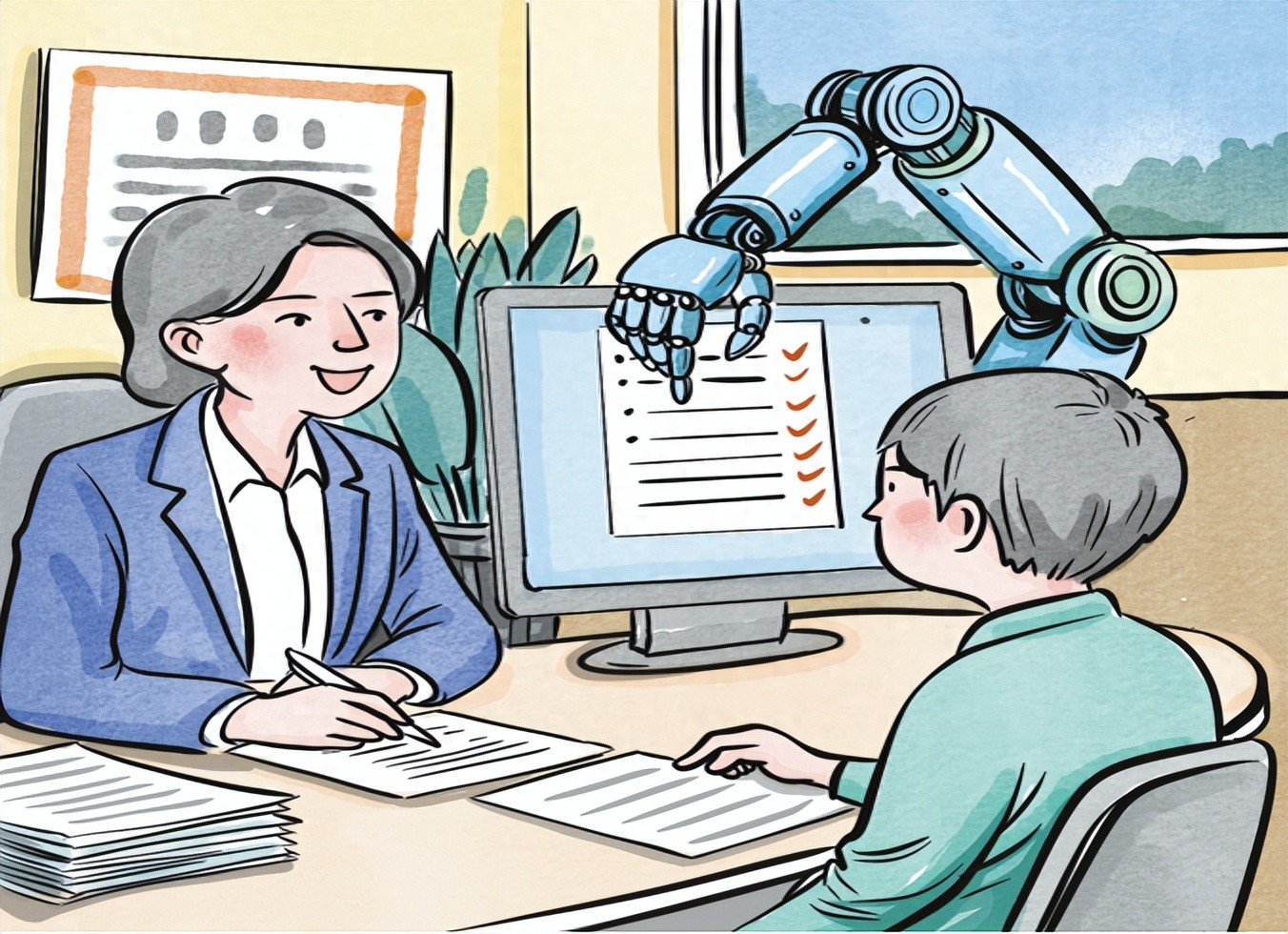
In a primary school in Beijing, a fifth-grade math teacher, Mr. Liu, exemplifies the implementation of the Action Plan. Every day after class, he uses an AI learning machine to comprehensively assess his students’ grasp of the day’s math concepts, eliminating the need for manual grading. The AI quickly generates detailed data analysis reports, clearly marking each student’s weak points—some struggle with geometry problems, while others frequently make mistakes in calculation steps.
“Previously, grading assignments and analyzing student performance took at least two hours each day. Now, with AI assistance, I can save that time and focus more on the students,” Mr. Liu said. He can concentrate on studying data about student performance and addressing their emotional needs. For students who are diligent but making slow progress, he uses the saved time to write targeted encouragement notes and rewards them with campus currency to acknowledge their achievements.
“Each of the 40 children in my class is a unique individual. I understand their personalities and experiences. This nuanced emotional care is something AI cannot replicate,” Mr. Liu stated, emphasizing his clear boundaries for AI use—AI handles error correction and data statistics, while teachers focus on guiding values and emotional support.
Notably, in November 2025, the Ministry of Education’s Expert Guidance Committee on Teacher Development released the “Guidelines for the Application of Generative AI by Teachers (First Edition)” (hereinafter referred to as the “Guidelines”).
Experts view this as the first national-level application standard specifically for teachers regarding generative AI, indicating that generative AI is beginning to systematically enter the education sector after initial explorations.
From a teacher’s perspective, the educational activities in the AI era aim for human-machine collaboration, promoting deep integration of technology and educational scenarios. From a student’s perspective, the use of AI technology facilitates multidimensional interactions between teachers, students, and technology, allowing students to engage in personalized learning based on their learning characteristics, thereby enhancing their learning efficiency and core competencies. Furthermore, AI-supported immediate feedback and adaptive learning paths can help students shift from passive acceptance to active exploration, fostering their independent learning abilities, according to Professor Yao Jinjun from Beijing Foreign Studies University.
Professor Yao believes that from the perspective of educational equity, the deep integration of AI technology into teaching can effectively break through spatial and temporal limitations and barriers to the flow of educational resources, helping to address the imbalance of educational resources between regions, urban and rural areas, and schools. From the perspective of educational governance and evaluation, AI technology can specifically resolve traditional educational governance issues such as subjective experience leading, rough resource allocation, and lagging teaching quality monitoring, optimizing the educational governance system. AI can also assist in the data collection and intelligent analysis of teaching behaviors, promoting the combination of outcome evaluation, process evaluation, and comprehensive evaluation, thereby facilitating scientific educational decision-making and refined management.
Reshaping Competencies: Strengthening the Foundation of the Teaching Profession
Cai Hailong, Vice Dean of the Institute of Education Policy and Law at Capital Normal University, believes that incorporating AI into teacher qualification exams is a necessary response to the basic competency requirements for teachers in the intelligent era. The teacher qualification exam essentially serves as a baseline evaluation of teaching ability. In the context where intelligent teaching has become the norm in some regions, the focus of the exam is not on complex algorithms or programming skills, but rather on whether teachers can apply AI in teaching contexts in a standardized and reasonable manner, while possessing basic ethical awareness.
“These contents will not increase the burden of exam preparation for teachers; instead, they will help teachers master core tools that can alleviate future professional burdens, thereby strengthening the foundation of teachers’ careers in the intelligent era from the source,” Cai Hailong stated.
Professor Yao Jinjun believes that by incorporating AI into teacher qualification exams, teachers can enhance their ability to identify ethical risks associated with educational AI products, allowing them to actively screen out inappropriate AI products for students in teaching scenarios, intercepting potential harms such as personal information collection and algorithmic bias, and becoming the first line of defense for students’ exposure to AI.
“Incorporating AI teaching into the knowledge structure and qualification certification system for future teachers fundamentally reshapes the logic of teacher training, constructing an integrated system from foundational training to qualification access and throughout their entire career. The goal is not to cultivate users who can operate AI tools, but to shape educational subjects who can master human-machine collaboration, uphold the essence of education, and possess ethical judgment capabilities regarding technology,” Cai Hailong explained.
Cai Hailong suggests a three-stage approach to training. In the foundational training stage, teacher education should reconstruct the curriculum system, systematically embedding AI literacy into core courses. Human-machine collaborative teaching design, AI educational ethics, data compliance, and privacy protection should be elevated from elective content to compulsory core courses. More importantly, the basic concept of human-machine collaboration should be established early in the training process, clarifying that technology must serve the fundamental task of moral education.
“In the qualification access phase, teacher qualification certification should shift from knowledge memorization to scenario capability orientation. The assessment focus should be on human-machine collaborative teaching design ability, critical judgment ability regarding AI content, and ethical response capability. Through case analysis and situational simulations, candidates should be evaluated on their ability to identify AI errors and value risks, design suitable teaching plans, and uphold privacy protection and educational responsibilities at the baseline. This ensures that both capability and ethical standards are maintained from the entry point,” Cai Hailong stated. In the career development phase, a continuous training and evaluation mechanism should be established throughout the entire career cycle. Human-machine collaborative literacy and technical scrutiny abilities should be included in onboarding training, continuing education, and professional title evaluation systems, but the evaluation should always center around educational effectiveness, avoiding falling into the trap of purely technical indicators.
Supporting Empowerment: Layered Support and Encouragement of Error
In interviews, experts emphasized that merely incorporating AI theoretical knowledge into teacher qualification exams does not guarantee that all teachers will effectively apply it in real teaching scenarios. Without ongoing post-training (teacher development), classroom observation assessments, and accountability mechanisms, there may be instances of “passing the exam but not being able to use it, not daring to use it, or misusing it.”
“Incorporating AI into teacher qualification exams requires establishing supporting layered support and error tolerance mechanisms, which is a prerequisite for sustainable reform,” Cai Hailong believes. Specifically, for newly hired teachers, the focus should be on maintaining access standards; for in-service teachers, especially those with longer teaching experience or in resource-poor areas, support should be prioritized rather than simple assessment.
“Additionally, a tolerance mechanism should be established to reduce teachers’ concerns about trying new technologies. More importantly, the human-centered stance of education must always be upheld. This requires clarifying the teacher’s primary position in the system to prevent technology from replacing the dominant role in teaching; in evaluations, purely technical stances should be avoided, and frequency of use should not be the core standard; and ethically, awareness of baseline issues should be strengthened, particularly in protecting student privacy and maintaining genuine teacher-student interaction. Ultimately, technology should empower education, not replace its essence,” Cai Hailong stated.
Cai Hailong believes that for the existing teacher workforce regarding training on AI usage, the key lies in adhering to a demand-oriented approach, implementing layered strategies, prioritizing baseline issues, and integrating learning and application. This will ensure that teachers can understand, learn, and effectively use AI. The construction of cognitive frameworks regarding generative AI should emphasize demystification, starting from the real needs of frontline teaching and embedding AI applications into daily teaching activities. The Guidelines should be the core content of training, prioritizing the clarification of compliance red lines and ethical requirements, and conducting warning education with typical cases to strengthen awareness of privacy protection, copyright, and educational responsibilities.
Journalist’s Note
I have been tracking the application of AI in education for several years, witnessing the gradual integration of AI into lesson preparation, student performance analysis, assignment grading, and every teaching aspect, breaking traditional teaching boundaries.
Incorporating AI into teacher qualification exams reveals a steadfast step towards the digital transformation of education and a bright future. This initiative not only standardizes the application of AI in education from the outset but also constructs an integrated system from teacher training, qualification access, to post-career development, allowing every teacher to continuously enhance their AI literacy and ethical judgment throughout their growth.
I envision a future where AI becomes the most capable assistant for teachers in classrooms: it can customize personalized learning paths based on each student’s cognitive characteristics, breaking the “one-size-fits-all” teaching dilemma; it can transcend spatial barriers, enabling students in remote areas to access quality educational resources, promoting educational equity; and it can assist teachers in optimizing teaching strategies, making classrooms more targeted and vibrant.
In this future, teachers will no longer be mere knowledge transmitters but will serve as guides, organizers, and protectors in human-machine collaborative teaching. They will skillfully use AI tools to enhance teaching efficiency while upholding the essence of education, finding a balance between technology and humanity. They will teach students to leverage AI to expand their cognitive boundaries while guiding them to maintain independent thinking, sharpening their critical skills and innovative capabilities amidst the information flood.
At that time, the integration of AI and education will no longer be a mere technical overlay but a quiet reshaping of the educational ecosystem—technology empowering education, and teachers nurturing its soul. The two will coexist and achieve mutual success, nurturing the growth of every child.
The river of education flows ceaselessly, and the tide of technology never rests. The integration of AI into education is not the endpoint but a new starting point for high-quality development in education in the intelligent era. My years of tracking educational development have instilled in me a firm belief that as long as we uphold the original intention of education, embrace technology with an open and inclusive mindset, and regulate technology with a professional and rigorous attitude, we can ensure that AI truly becomes the “wings” of education. In that future, every teacher will realize their professional value in human-machine collaboration, and every child will grow under the sunlight of the intelligent era, becoming a new generation that can adapt to and lead the future.
Comments
Discussion is powered by Giscus (GitHub Discussions). Add
repo,repoID,category, andcategoryIDunder[params.comments.giscus]inhugo.tomlusing the values from the Giscus setup tool.